


Roman Kamushken
A white label SEO tool is software you rebrand and resell under your agency name, so clients never see the vendor's logo. Reselling beats building when you need the tool live in weeks and the workflow is standard. Build in house only where a tool encodes your own method.
TL;DR
→ White label SEO tools are software you rebrand, not services you outsource. The dashboard and the reports carry your name.
→ Resell the generic layers such as rank tracking and audits, and build only what matches your method.
→ Branded reporting is usually the first tool agencies take white label, because the client sees it every month.
→ Vet on data export and account ownership before price, plus per-client limits that decide whether the account stays profitable.
What counts as a white label SEO tool
A white label SEO tool is any SEO software a vendor lets you rebrand and resell. It appears under your logo, on your domain, with your colours. Agencies meet these tools in six categories, and each one has a different build-or-buy answer.
Rank tracking. Software that checks where client pages rank for target keywords, then stores the history. Vendors usually let you rebrand the dashboard and the exported reports.
Reporting. The layer that pulls data from several sources into one branded client view. This is the tool most agencies buy first, for the reason that the client sees it every month.
Audits. On-page and technical checks that produce a fix list. Standalone audit tools are cheap to resell, and they feed the reporting layer above.
Backlink data. A database of referring domains and anchors, plus link changes over time. Building this in house is impractical because the data comes from a large, constantly updated crawl.
Content tools. Briefs and outlines, plus content scoring. Worth reselling when your writers already use them, weaker as a client-facing product.
Proposals. Branded document tools that turn your audit and rank data into a pitch. Small category, but it closes deals faster than a slide deck.
Tools handle the software layer. The service model that wraps around them is a separate decision, covered in our guide to white label SEO reseller programs, and our SEO tools compared review covers the standalone products.
Resell or build in house
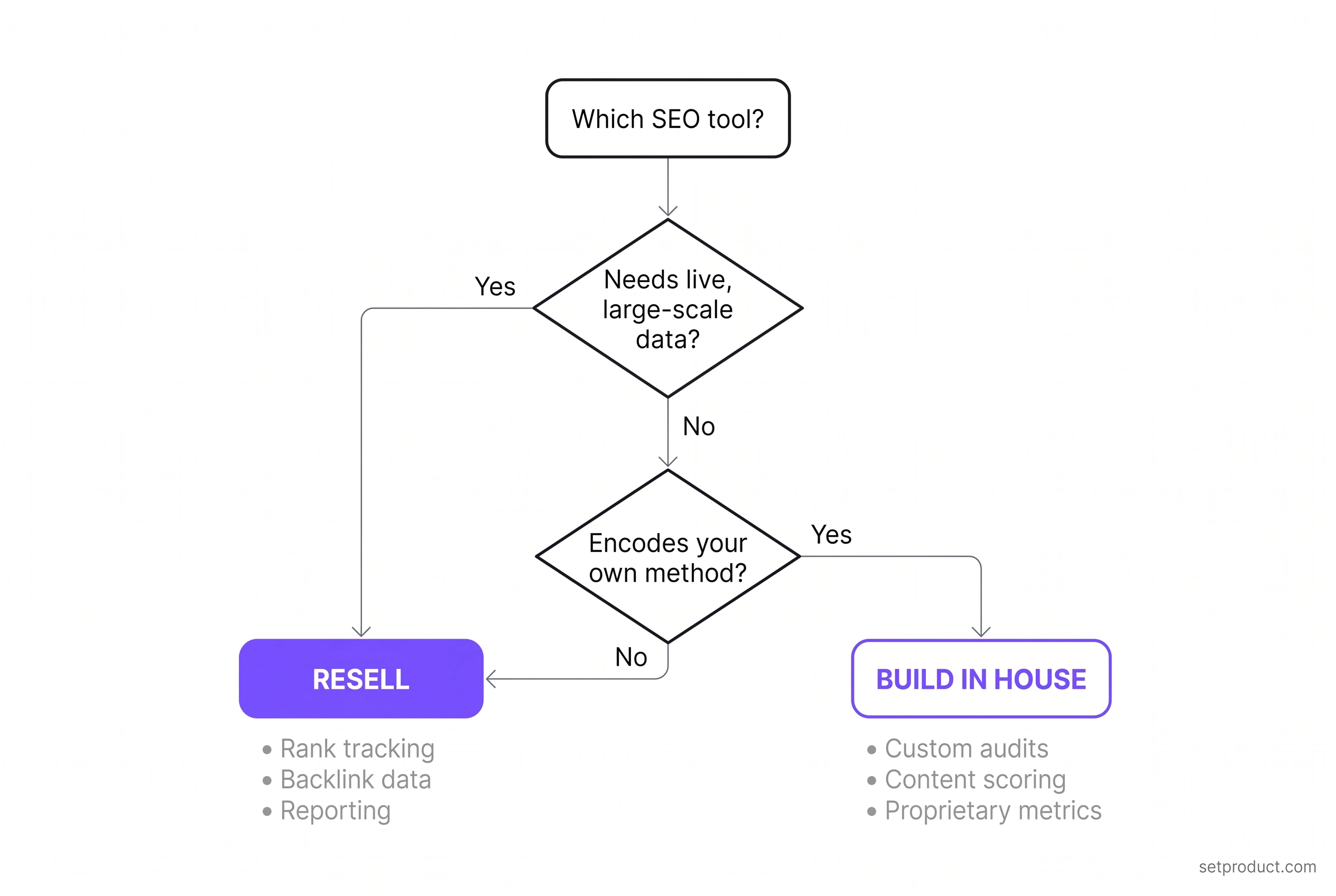
The build-or-buy call changes by category. Most agencies resell the layers that need live data, and build only what mirrors their own process. The table below is the short version of that decision.
If you are weighing a tool layer against a vendor that bundles tools with delivery, our white label SEO platforms and resellers comparison covers six options and what each one includes.
| Category | Resell if | Build if | What you give up |
|---|---|---|---|
| Rank tracking | You want history in weeks and no crawl cost | You track a niche where public data misses small sites | Control over crawl frequency |
| Reporting | Clients need a branded monthly view now | Your method needs a custom metric no vendor exposes | Flexibility in how metrics combine |
| Audits | The fix list matters more than the engine | Your process depends on a specific rule set | Depth of the underlying checks |
| Backlink data | You need coverage beyond your own outreach | You only resell links you place yourself | Scale of the referring domain index |
| Content tools | Writers already work inside the vendor's flow | Your editorial standard is the product | Fit to your own style rules |
| Proposals | You sell the same packages repeatedly | Every pitch is bespoke | Speed against personalisation |
The reporting layer
Reporting is usually the first tool an agency takes white label. The client sees it every month, so the brand on that report does quiet retention work long after the invoice clears.
Three details decide whether a branded report holds up.
→ Your domain. The report should live at reports.youragency.com, not on the vendor's URL.
→ Your identity. Logo and colours across the whole report, cover sheet included.
→ Data export. Clients change agencies and you change tools. If the data does not leave, it was never yours to keep.
A branded report should reflect what actually moves rankings. Google's SEO starter guide names the basics any client report should track, which is a useful bar when a vendor shows you a demo.
The cost math
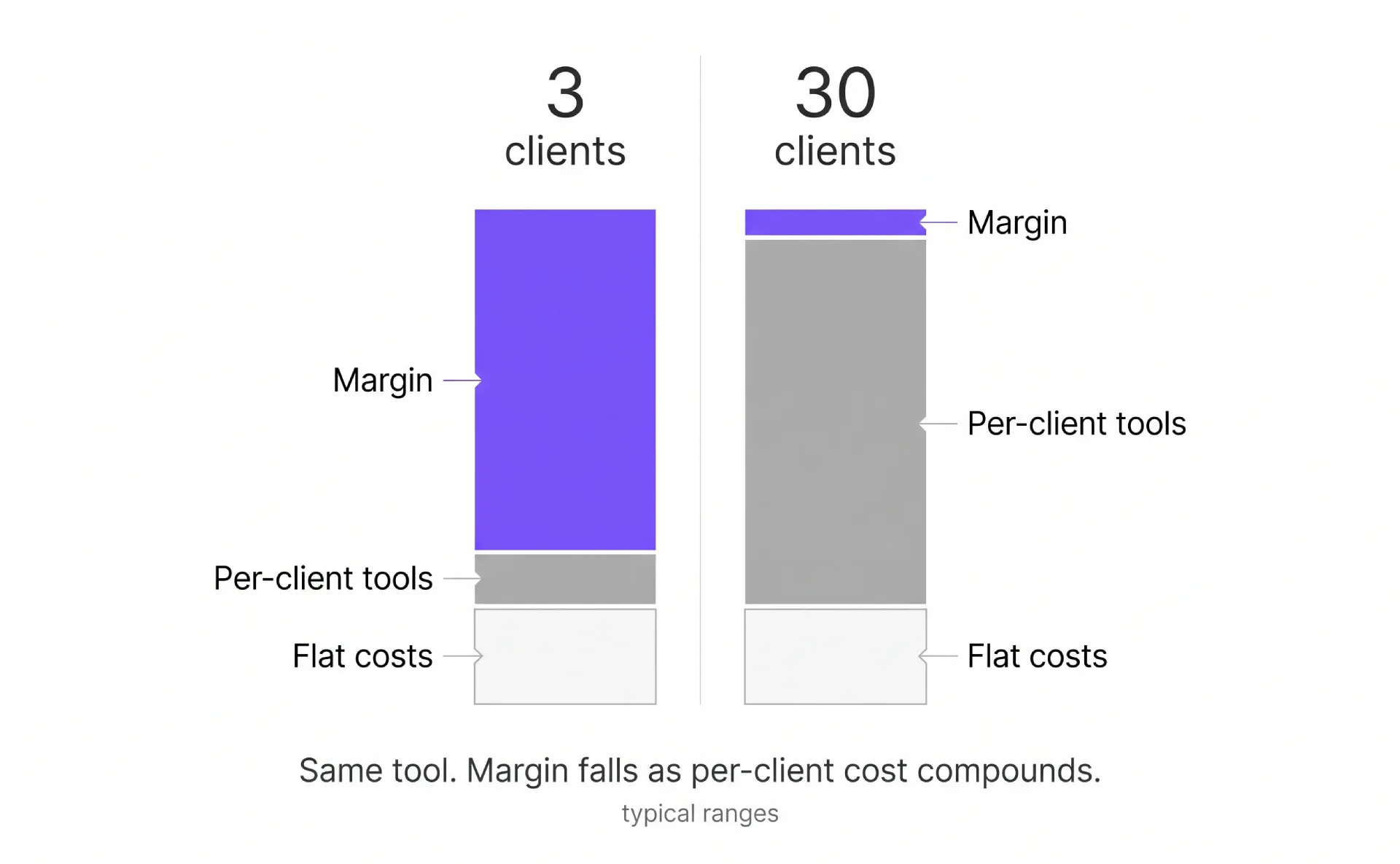
Tool pricing is usually per client or per project, and it scales with your book. The ranges below are typical for small agencies, and they move with your market.
| Tool category | Typical tool cost | Typical client price |
|---|---|---|
| Reporting | $20 to $50 per client / month | $100 to $250 per client / month |
| Rank tracking | $10 to $30 per client / month | Folded into retainer |
| Audits | $0 to $25 per audit | Folded into retainer |
| Backlink data | $100 to $300 per month flat | Folded into link work |
Treat every figure here as working range, not a quote. Real pricing moves with your niche and the size of each account.
The pattern is consistent. Reporting and rank tracking carry the clearest markup because the client sees the output. Backlink data is a flat cost you spread across clients, so it hurts the margin most when your book is small. If link work is part of the offer, our guest posts vs niche edits guide compares what each link type costs.
How to vet a white label tool
Seven checks separate a tool you can resell for years from one you regret in month two.
❶ Branded domain. Can reports and the client login sit on your domain, or only inside the vendor's app?
❷ Data export. Can you pull the raw data out, or only a PDF the vendor controls?
❸ Account ownership. Who holds the client accounts if you leave, and can they move with you?
❹ Per-client limits. Does pricing cap clients or seats, and what happens at the cap?
❺ Support. Ask for the real response time. A tool that answers in two days fails the client who escalates.
❻ Price per client. Model the cost against your smallest account, not your average one.
❼ Exit. Get in writing what happens to your data and your client history when the contract ends.
These checks apply to any tool, and white label vendors add their own terms on top. Our white label SEO platforms comparison covers the vendors that bundle tools with delivery.
Risks
Four risks are worth naming before you resell any tool.
Lock-in. Once reports, client logins and history live in one vendor, moving means rebuilding each account from scratch.
Rising cost with scale. Per-client pricing is cheap for three clients and painful for thirty. The tool that fits today can price you out next year.
Data that does not travel. Some vendors export a summary, not the underlying rows. You cannot rebuild a client's history elsewhere, and the client cannot take it either.
Tools you already own. Agencies often add a new subscription that repeats what a current tool already does. Audit the stack before you add another line item.
Frequently asked questions
What is a white label SEO tool?
A white label SEO tool is SEO software a vendor lets you rebrand and resell. Clients log in on your domain and see your logo, not the vendor's. Common examples are branded reporting dashboards and rank trackers, plus audit tools. You pay the vendor per client or per month, and you bill the client your own price.
Is white label reporting worth it for a small agency?
Usually yes, because the report is what the client sees most often. A branded monthly report supports retention more than any feature list, and it costs a fraction of building a reporting stack. Test one report with three clients before you commit to an annual plan.
What is the difference between white label SEO software and a reseller program?
White label SEO software is the tool layer you rebrand and put in front of clients. A reseller program is the wider service model where a vendor also delivers the SEO work. Many agencies start with software for reporting, then add a reseller program for delivery later.
Which white label SEO tools should an agency resell first?
Start with reporting and rank tracking, because both are visible to the client every month. Add backlink data only when you sell link work, since it is a flat cost you spread across accounts. Audit tools come next, and they feed the reporting layer you already resell.
Can you white label a rank tracker or a dashboard?
Yes, most rank trackers and dashboards offer a white label mode that swaps the vendor's logo and domain for yours. Check the export options and who owns the client accounts before you commit. Some vendors brand the interface but keep the raw data locked inside their system.
Where the tool layer pays off
A white label tool buys you speed. You get a branded dashboard and a report a client can read, without a build cycle or a new hire. Resell the layers that need live data, and build only where a tool carries your method. Then vet on export and ownership before price, because a tool you cannot leave is the most expensive one.
If link building is the piece you plan to resell first, Setproduct's guest posting service is built for agencies that keep placements under their own brand. Publish with Setproduct to see how it works, and our guide to guest posting opportunities covers where to buy placements and what they cost.