

Connor Patterson
This guide walks through the ten best real estate app development companies, explains why various product types require different technical approaches, and gives you a practical roadmap for the 90 days after you make your decision.
Why business models in real estate app development are different product architectures
Every real estate product type has a different definition of core features:
- For a rental marketplace, core features are search and discovery, listing management, tenant screening, lease generation, and payment processing. The product success is determined on how well it handles the transaction between landlord and tenant, and how reliably it processes recurring payments.
- For a brokerage platform, the core is agent productivity: MLS/IDX data feeds, lead routing, CRM pipeline management, showing schedules, and offer tracking. The product needs to reduce friction in that relationship across a long, multi-touch sales cycle.
- For a property management tool, the core shifts to operational reliability: maintenance request handling, vendor management, document storage, compliance tracking, and financial reporting across a portfolio.
- For an investment or fractional ownership platform, the architecture centers on financial data accuracy, regulatory compliance, investor reporting, and in some cases secondary market infrastructure. The user is making capital allocation decisions, and the product needs to support that with data they can trust.
These differences drive decisions about data models, third-party integrations, notification systems, user roles, and performance requirements. A team that has built one type well is not automatically equipped to build another.
Specialization also shows up in how vendors structure the engagement itself. Some firms, like Binary Studio, build dedicated engineering teams around real estate products, which suits companies that want to keep product decisions in-house while outsourcing the build. Others sell fixed-scope projects end to end. Deciding which model fits your team before you review portfolios will save you from comparing vendors that solve fundamentally different problems.
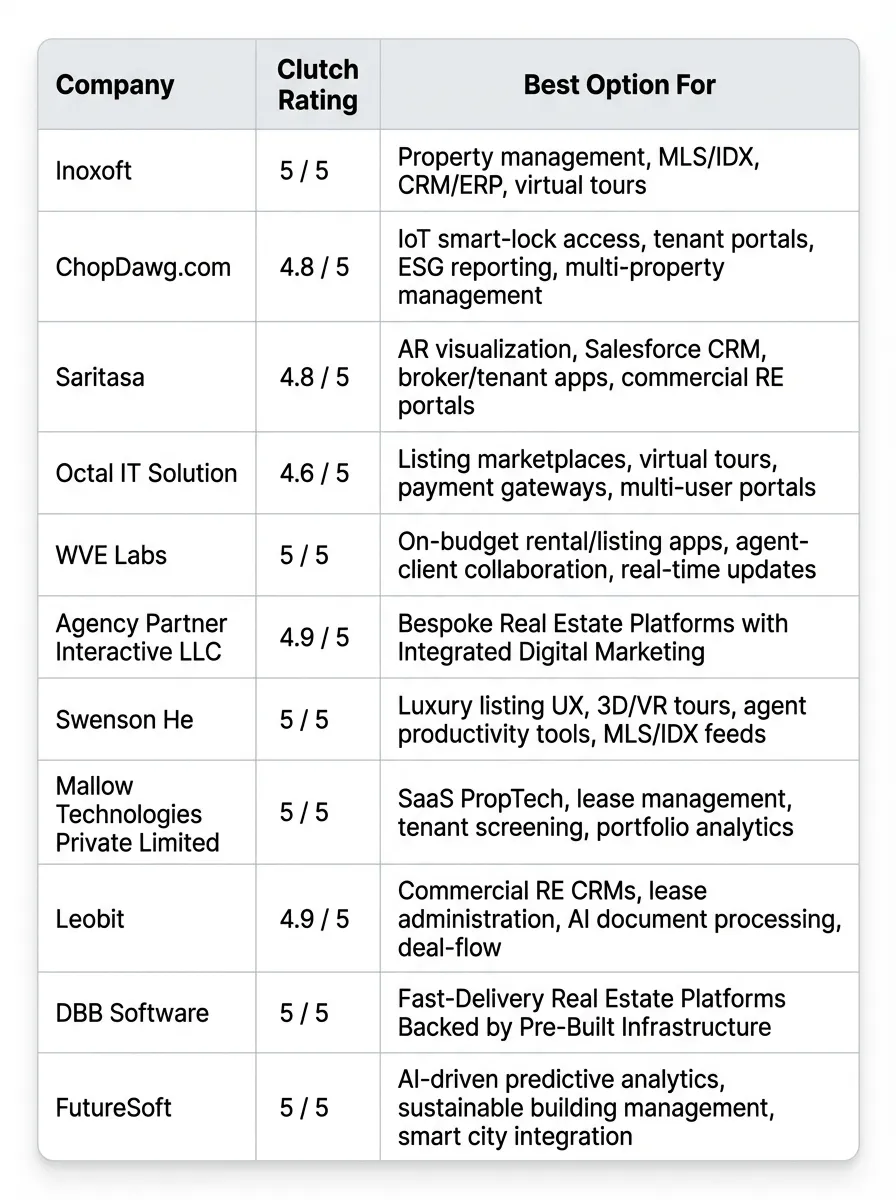
The shortlist: Top real estate app development companies reviewed
The companies below made this list because they have shipped real estate products, have verified client ratings, and demonstrated technical capabilities that are specific to the industry.
Inoxoft
Hourly rate: $25 - $49
Best for: Teams that need a single partner to take a real estate product from strategy through launch and post-release support.
Consistently ranked among the best real estate app development companies, Inoxoft has been building PropTech since 2014. The depth of its expertise shows up in the details. Their 200+ in-house engineers have shipped over 200 custom solutions covering property listings, tenant apps, ESG compliance, and AI-powered energy management. Before writing code, they map every workflow to how your team operates. This kind of thinking is why their work holds up at scale. One real example: a client managing 1,200+ rental units was losing nearly 17 hours a week to chasing tenants and manually updating spreadsheets. After Inoxoft introduced automated invoicing and reminders, the time dropped to 3-4 hours.
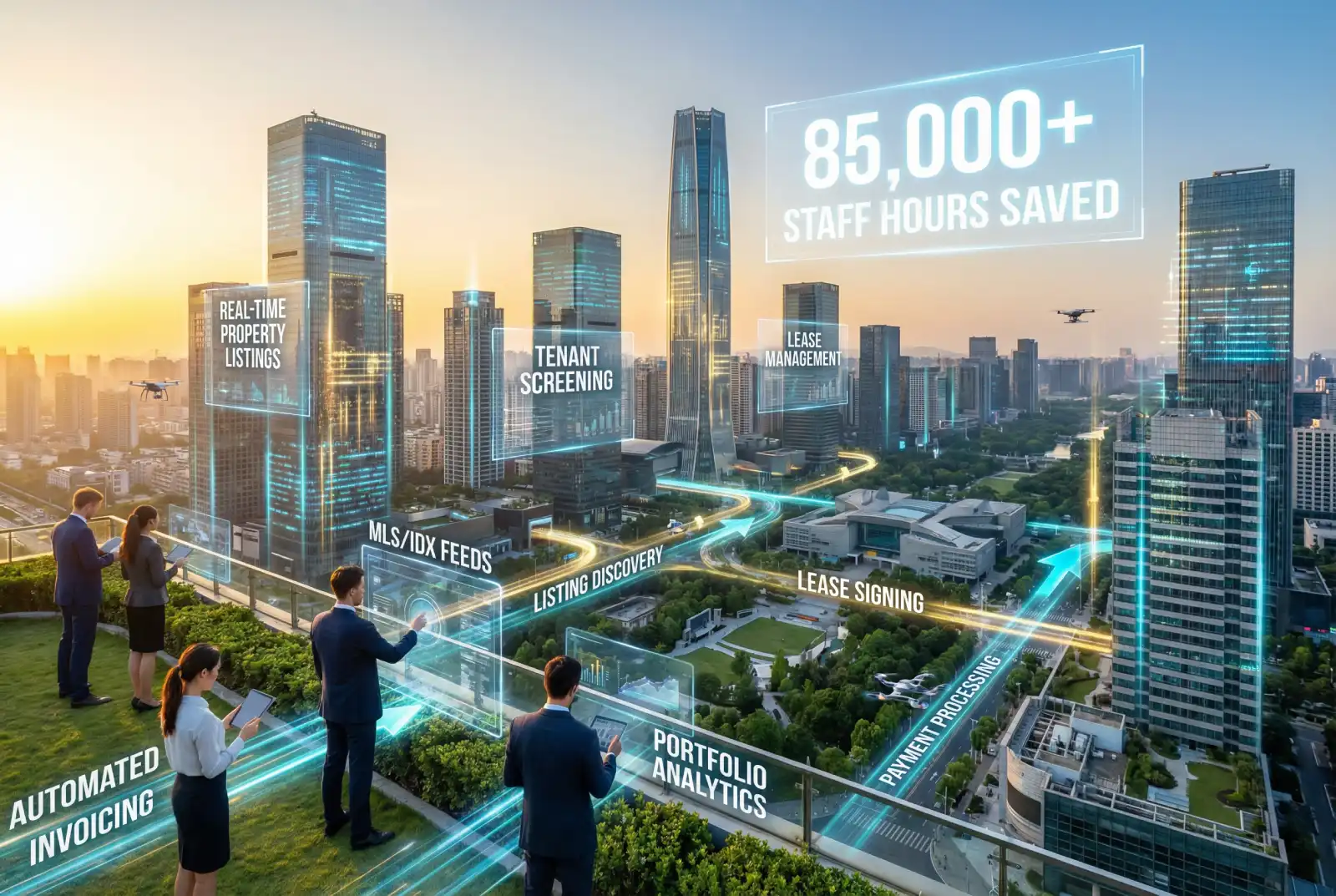
Across their real estate engagements, clients have reduced administrative work by as much as 40% for a portfolio of 10,000 units, which can translate to roughly $600,000 in annual savings on operational expenses alone. On the product side, their platforms have delivered outcomes like saving 85,000+ staff hours and boosting profits by 25%. With top Clutch ratings, an 94% client retention rate, and a team where nearly all engineers are mid-to-senior level, this company is a strong choice for the real estate business that has outgrown off-the-shelf tools and needs a partner who understands what's at stake when software touches leases, payments, and people's
ChopDawg.com
Hourly rate: $50 - $99
Best for: Luxury/vacation rental and tenant-experience PropTech.
ChopDawg has been building apps since 2009, and its PropTech work reflects that maturity. Tenant portals, IoT smart-lock integrations, virtual tours, ESG dashboards, and multi-property management tools have clearly been thought through at the UX level. They're a good fit for luxury and vacation rental products where the physical-digital experience matters to the end user.
Operationally, they're reliable in ways that count: on a recent real estate investing platform, they delivered two months ahead of schedule while staying under budget. Pricing is fixed and monthly, while a 92% client retention rate suggests the relationship doesn't end at launch.
Saritasa
Hourly rate: $100 - $149
Best for: Custom enterprise real estate software with AR/VR and mobile focus.
Saritasa's real estate work sits firmly at the enterprise end of the market. Its AR/VR capabilities are what set them apart. The immersive property tours, interactive visualizations, and design simulations are built to engage buyers, tenants, and investors. This makes this team a fit for commercial real estate firms that need to present unbuilt or renovated spaces to prospects before construction wraps. Salesforce CRM integration, secure data syncing, and role-based broker and tenant mobile apps round out a portfolio that reflects real familiarity with how enterprise real estate organizations operate.
Clients have praised their collaborative approach and ability to navigate complex technical requirements, with timely delivery and clear communication cited across recent reviews. At this price point, you pay for a US-based team that won't need hand-holding on compliance, security, or stakeholder-facing polish.
Octal IT Solution
Hourly rate: $25 - $49
Best for: Scalable real estate marketplaces and management systems.
Octal IT Solution brings 17+ years of software development experience to the real estate industry, offering a range of services including property listing platforms, MLS integrations, agent dashboards, brokerage management tools, and multi-user portals. Their brokerage software consolidates listings, client communications, and transaction processes into a single, cloud-based back-office. This is useful for mid-size agencies that need operational clarity without commissioning a full custom CRM build.
This team carries an 80% repeat business rate and has executed 2,300+ projects globally. Estimates are described by long-term clients as consistently spot-on and reasonable, with on-time, on-budget delivery.
WVE Labs
Hourly rate: $50 - $99
Best for: Budget-conscious real estate platform development.
WVE Labs is a California-based product studio with a practical angle on real estate. Roughly half their team has personally been through a property purchase, sale, or mortgage in the past two years. This means they don’t guess at what buyers, renters, and agents need from software. Their real estate work covers custom mobile apps for property listings and rentals, integrated chat and video tools for agent-client communication, and real-time infrastructure for listing status and offer tracking.
This agency builds for founders who need a focused, launchable product. What clients notice most is the reliability. If you work with defined timelines and limited runways, such consistency matters more than any feature list.
Agency Partner Interactive
Hourly rate: $100 - $149
Best for: Bespoke real estate platforms combining product development and ROI-driven digital marketing..
This Dallas-based studio sits at an intersection of product development and digital marketing. With 1,800+ completed projects and a track record with growth-focused businesses, they bring a commercially minded lens to real estate software that pure dev shops often lack. Their real estate portfolio spans bespoke listing platforms, rental apps, private mortgage lending websites, and investor tools for client tracking and transaction management. All platforms are built by the same team, which can also handle SEO, paid media, and conversion strategy once the product is live.
For real estate businesses looking for a single partner to cover both the product and go-to-market sides, this team can be a good choice. Communication is responsive within hours, project management is structured, and specialists are available round-the-clock across time zones.
Swenson He
Hourly rate: $100 - $149
Best for: High-end, design-forward real estate apps and digital experiences.
Founded in 2014 by two MIT graduates, Swenson He has built a reputation for high-quality in-house development, as evidenced by the consistency of its real estate work. Their immersive 3D and VR property tours, elegant listing interfaces, and seamless MLS/IDX integrations are built for markets where how a property looks on screen influences buyer perception and deal value. Agent productivity tools and client portals round out the operational side, because user-friendly software still needs to perform reliably under daily use. Their "Final 1%" methodology means engineers keep asking, "What more can be done?" at every step.
The client experience reflects that standard. A 97% client re-engagement rate suggests that reputation holds across projects. For real estate teams where presentation quality is part of the product, Swenson He is one of the few shops where design ambition and engineering execution move together.
Mallow Technologies Private Limited
Hourly rate: < $25
Best for: SaaS-style PropTech platforms and custom real estate CRMs.
With 14+ years of experience and a 100% positive feedback rate on Clutch, Mallow Technologies emphasizes technical expertise and strong communication. This punches well above its price point. Their real estate work is built around a SaaS-first mindset (e.g., multi-tenant, cloud-native platforms with lease automation, document e-signing, tenant screening, and portfolio analytics).
Their development culture has earned them a place among Clutch's top 1,000 global service providers for 2025. For early-stage PropTech teams or growing property managers who need a reliable technical partner without enterprise-level spend, Mallow is one of the most reliable options on this list.
Leobit
Hourly rate: $25 - $49
Best for: Enterprise commercial real estate CRMs and tools.
Named Top Real Estate Software Developer by Clutch, this agency has earned its recognition through projects that move numbers. Their custom applications serve over 1.5 million users and have facilitated $1.4 billion in real estate transactions. For commercial real estate, their lease administration systems and deal-flow management tools are built for the operational realities of the asset class: long lease terms, multi-stakeholder ownership structures, and documentation volumes.
For enterprise real estate teams that need a technical partner who understands the domain deeply enough to push back on scope decisions, this track record matters.
DBB Software
Hourly rate: $25 - $49
Best for: Fast-Delivery Real Estate Platforms Backed by Pre-Built Infrastructure
DBB Software's core differentiator is its Pre-Built Solutions, a library of production-tested solutions that cuts development time by up to 50% and gets teams to a working proof of concept within 2 weeks. They’ve worked directly with JLL, a Fortune 500 commercial real estate firm operating across 80 countries, to modernize property management operations through a cloud-based SaaS platform with Yardi and MRI Software integrations.
What makes them a reliable bet at this price point is the consistency behind the speed. Over 80% of clients stay for 7+ years, and most team members have worked together for 5+ years. Client feedback across platforms emphasizes high code quality, punctuality, and a proactive approach to surfacing improvements before problems surface. For real estate teams with a defined launch window and no appetite for slow starts, DBB's infrastructure-first approach reduces much of the usual early-stage friction.
What happens after vendor selection: The first weeks that define success
This chapter is a practical framework for executives and product owners who have selected a partner and need to know what to do next.
Week 1–2: Run a Structured Discovery Workshop
The first two weeks should be spent building a shared understanding of what you're building, why, and for whom — not writing code. The output isn't a slide deck; it's a living reference document that both sides can point to when scope debates emerge at week 11.
Week 2–4: Align on KPIs Before the Roadmap Is Set
By week four you should have agreed on the specific metrics that define success at 30, 60, and 90 days post-launch. KPIs set before the roadmap is locked carry real weight; KPIs defined after the fact are just post-hoc justification.
Week 3–5: Complete a Technical Audit of Existing Assets
A technical audit covers current codebase quality, documentation, third-party integration reliability, and licensing terms. The deliverable should be a written assessment with explicit flags for anything that will affect the timeline, architecture, or budget.
Week 6–8: Establish Stakeholder Ownership and Review Protocols
Assign a single internal product owner with actual authority to approve designs, approve feature implementations, and make trade-off calls. Identify everyone else who needs to be consulted (e.g., legal, compliance, operations) and get their expected review turnaround in writing before the project depends on them.
Week 9: Review the Foundation Before It Gets Built On
Before the project moves into feature development, run a foundation review. This is a structured assessment of the technical and process decisions made in the first phase of the engagement.
The foundation review should cover:
- whether the architecture aligns with your performance and scalability requirements;
- whether the data model supports the features planned for phases two and three;
- whether the testing coverage is sufficient for a production real estate system;
- whether the team communication and delivery cadence are working.
If anything in the foundation review surfaces a significant concern, address it now.
The ten companies in this guide represent different strengths, geographies, and specializations. The right vendor for your project is the one whose experience matches your business model, not just your budget range. A vendor who has shipped ten rental marketplaces will make better decisions for your rental marketplace than a more prestigious agency that has never dealt with recurring payment logic, tenant screening flows, or lease compliance requirements.